How do adaptogens work for focus and stress? The Cognizil guide
Adaptogens are a group of herbs — ginseng, eleuthero and astragalus among them — traditionally used to help the body adapt to stress, and modern research suggests they work by nudging the stress-response system back toward balance. The science is promising but still maturing, so adaptogens are best understood as everyday support for steady focus and resilience, not as a treatment for any condition.
Herbs that help the body handle stress — the short version.
- The concept
- An adaptogen is a plant used to help the body resist and recover from physical and mental stress, aiming for balance rather than a stimulant “hit.”
- The mechanism
- Research points to the stress-response system — the HPA axis and cortisol signalling — as where adaptogens appear to act, though the picture is still being mapped.
- For focus
- By supporting a calmer, steadier baseline, adaptogens like panax ginseng and eleuthero are traditionally linked with mental energy and sustained attention.
- In Cognizil
- Cognizil pairs three adaptogens — ginseng, eleuthero and astragalus — with chromium and supporting nutrients in a once-daily liquid dropper.
“Adaptogen” is now a wellness buzzword, but the idea has real roots in pharmacology and traditional medicine. This guide explains what an adaptogen actually is, what the evidence says about how they work, and where the three adaptogens inside Cognizil fit a routine built for calm, steady focus.
What is an adaptogen, exactly?
An adaptogen is a plant compound traditionally used to help the body resist and adapt to stress — physical, chemical or emotional — and return more easily to balance. The term was coined by Soviet scientists in the mid-twentieth century for substances that seemed to raise the body’s non-specific resistance to strain. To earn the classic label, a plant had to be broadly safe, help normalise the body regardless of the direction of stress, and avoid a stimulant’s crash. Ginseng, eleuthero, rhodiola, ashwagandha and astragalus are among the best-known examples.
The key distinction is adaptogen versus stimulant. Caffeine pushes the system harder in one direction; an adaptogen is meant to help the system regulate itself, which is why its effects are subtle, cumulative and steadying — support, not stimulation.
How do adaptogens work in the body?
Adaptogens are thought to work mainly through the body’s central stress-response system, the hypothalamic-pituitary-adrenal (HPA) axis, which governs how much cortisol and other stress hormones you release. When you meet a challenge — a deadline, a poor night, a hard workout — this axis fires. Laboratory research suggests adaptogens interact with that signalling and with cellular stress-protection pathways, helping the response switch on when needed and settle afterwards rather than staying stuck in overdrive.
That is the leading theory, and its limits deserve honesty. Much of the mechanistic work comes from cell and animal studies, and human trials are often small and varied in quality; the U.S. National Center for Complementary and Integrative Health notes the evidence in people is still limited or mixed for many popular botanicals (NCCIH). Where human data do exist they are modest: a systematic review of ashwagandha and cortisol in stressed adults found reductions in some trials but flagged small samples and inconsistent methods (Della Porta et al., Nutrients, 2023). The accurate statement is this: adaptogens appear to modulate the stress response and several show encouraging early results, but none of that amounts to a proven treatment for a medical condition.
Why are adaptogens linked with better focus?
Adaptogens are connected to focus because attention and stress are two sides of the same coin: a mind flooded with cortisol struggles to concentrate, while a calmer nervous system holds attention more easily. By supporting a steadier stress baseline, adaptogens like panax ginseng and eleuthero are traditionally linked with mental energy, reduced fatigue and sustained concentration, and some small studies report better reaction time and alertness — though results are not uniform.
Set expectations correctly. Adaptogens do not deliver the jolt of an energy drink; they are more a background adjustment that, over weeks, may soften a frazzled afternoon into a merely busy one. Our guide on improving memory and focus naturally covers the sleep, movement and nutrition habits adaptogens are meant to support, not replace.
Which adaptogens are in Cognizil, and what do they do?
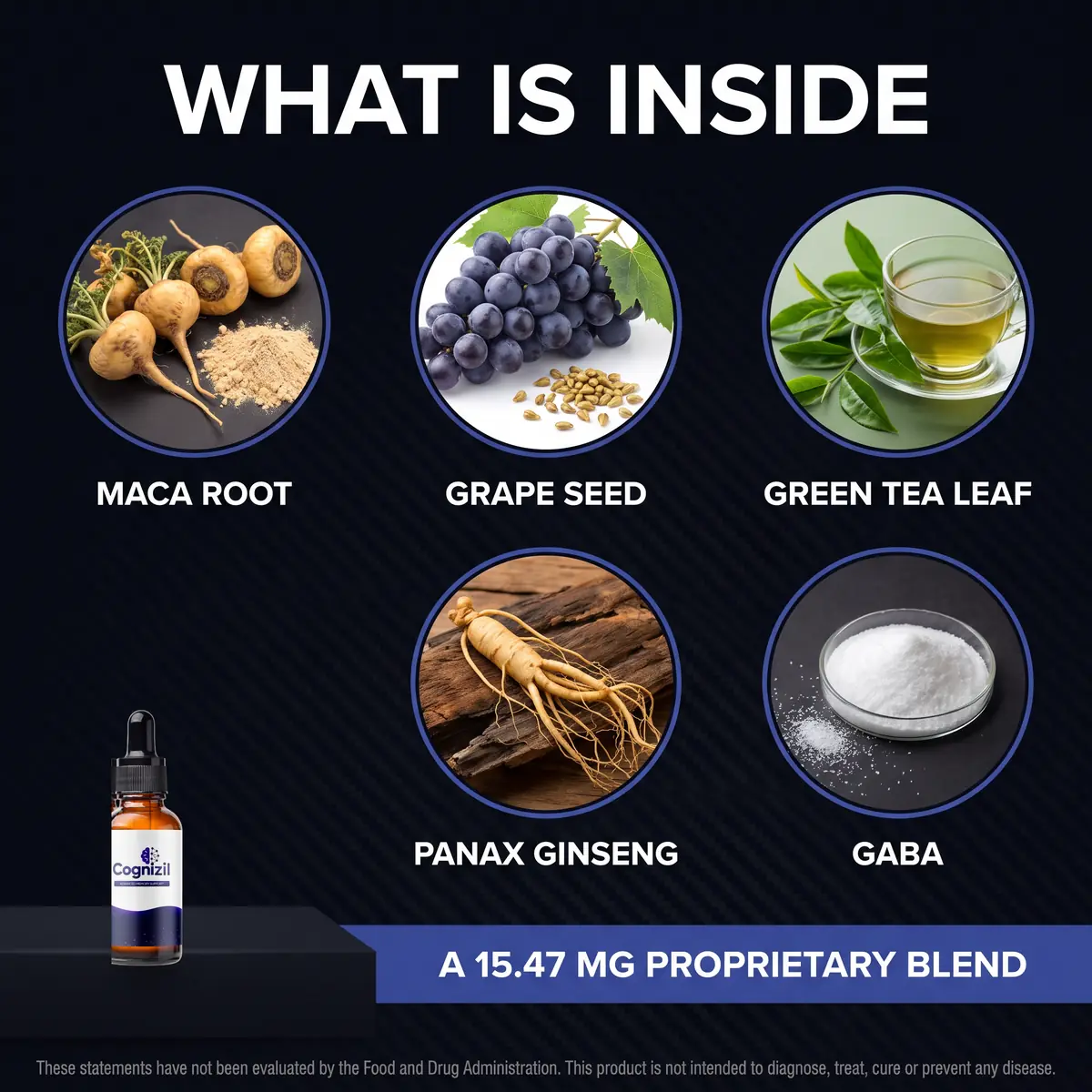
Cognizil includes three classic adaptogens — panax ginseng, eleuthero root and astragalus root — inside its 15.47 mg botanical and amino-acid blend, alongside chromium and supporting ingredients such as maca, green tea, GABA and L-tyrosine. Here is how each is traditionally understood.
Panax ginseng — the classic tonic
Panax ginseng is the most studied adaptogen and a cornerstone of traditional East Asian medicine, used for centuries as a tonic for energy, resilience and mental sharpness. Its active compounds, the ginsenosides, drive most modern research, and a 2025 meta-analysis pooling ginseng trials on standard cognitive scales found small and inconsistent changes (Kim et al., Complementary Medicine Research, 2025) — so, as NCCIH notes, human evidence for specific benefits remains preliminary (NCCIH).
Eleuthero root — endurance under load
Eleuthero (Eleutherococcus senticosus), historically marketed as “Siberian ginseng,” is a distinct plant with its own tradition centred on stamina and resistance to fatigue, popularised by twentieth-century research on endurance under stress. A 2025 review in Molecules gathers what is known about its eleutheroside chemistry and adaptogenic reputation (Kos et al., Molecules, 2025). As with ginseng, the human data are promising in places and thin in others, which is why it belongs in a supportive blend rather than a stand-alone fix — our full profile of eleuthero for steady focus walks through the trials one by one.
Astragalus root — the resilience herb
Astragalus (Astragalus membranaceus) is a staple of traditional Chinese medicine, valued as a restorative “qi” tonic and studied today largely for antioxidant and cellular-protection properties. It rounds out Cognizil’s adaptogen trio around the theme of everyday resilience.
See the exact adaptogen dose in Cognizil →
How do the main adaptogens compare?
No two adaptogens are alike, and honest comparison means separating tradition from proven fact. The table below summarises the best-known adaptogens by traditional role and the general state of human evidence — context, not medical claims.
| Adaptogen | Traditional role | State of human evidence |
|---|---|---|
| Panax ginseng (in Cognizil) | Energy and mental-sharpness tonic | Most-studied adaptogen; early trials on fatigue and cognition, results mixed. |
| Eleuthero root (in Cognizil) | Stamina and endurance under stress | Some research on fatigue resistance; overall still limited. |
| Astragalus root (in Cognizil) | Restorative resilience tonic | Mostly antioxidant and lab research; human data developing. |
| Rhodiola rosea | Anti-fatigue, mood steadiness | Several small trials on fatigue; promising but not conclusive. |
| Ashwagandha | Calm and stress resilience | Some trials report lower perceived stress; more research needed. |
Put the adaptogen trio to work daily
Cognizil is a once-daily dropper pairing three adaptogens — ginseng, eleuthero and astragalus — with chromium and a 15.47 mg blend. The six-bottle bundle is the best value at $49 per bottle, with free U.S. shipping and a 180-day guarantee.
Order Cognizil — from $49/bottleHow should you take adaptogens for the best chance of benefit?
Because adaptogens are cumulative rather than instant, the single most important rule is consistency: take them daily and give the routine several weeks before you judge it. A few practical points help.
- Take them at the same time each day — for Cognizil, one dropperful, shaken and swallowed, with a meal.
- Do not expect a stimulant kick. Adaptogens work in the background; an instant lift is what caffeine is for.
- Pair them with the fundamentals — sleep, movement and steady meals are what adaptogens support, not replace.
- Give it four to eight weeks, since both tradition and study use lean on sustained intake.
- Check with a pharmacist if you take medication, as some adaptogens can interact with drugs like blood thinners or diabetes medicines.
For the full formula beyond the adaptogens, our guide to nootropic ingredients for focus and memory explains how chromium, L-tyrosine and green tea fit alongside the roots, or see the complete ingredients section. If you are weighing herbs against lab-made compounds, our comparison of natural versus synthetic nootropics maps the two routes.
Are adaptogens safe, and when should you talk to a doctor?
For most healthy adults, the well-known adaptogens are generally well tolerated at supplemental doses, but “natural” does not mean “risk-free.” The table below sorts the common considerations at a glance.
| Consideration | What to know |
|---|---|
| General tolerance | Usually mild; occasional reports of headache, digestive upset or trouble sleeping if taken late. |
| Medication interactions | Some adaptogens may interact with blood thinners, diabetes or blood-pressure medicines — ask a pharmacist. |
| Pregnancy & nursing | Safety data are limited; avoid unless your doctor advises otherwise. |
| Existing conditions | If you have a diagnosed condition, confirm any new supplement fits your care plan. |
| Realistic expectations | Effects are supportive and gradual; adaptogens do not diagnose, treat or cure any disease. |
Speak with your doctor before starting any adaptogen if you are pregnant or nursing, under 18, take prescription medication, or have a health condition — and see one promptly if stress or low mood is persistent, because adaptogens are wellness support, not a substitute for care. Compare the multi-month packages and pricing once it is a fit, since the gradual nature of adaptogens is why most people choose a longer supply.

Frequently asked questions
How do adaptogens work in simple terms?
Adaptogens are herbs traditionally used to help the body adapt to stress. Research suggests they interact with the stress-response system — the hypothalamic-pituitary-adrenal axis — to help nudge it back toward balance. The evidence is promising but still developing, so they are best seen as support, not a treatment.
Are adaptogens good for focus?
Adaptogens like panax ginseng and eleuthero have a long tradition of use for mental energy and steady attention, and some small human studies report improvements in fatigue and reaction time. Effects are usually modest and build over weeks, and they work best alongside good sleep, diet and movement.
Which adaptogens are in Cognizil?
Cognizil includes three classic adaptogens — panax ginseng, eleuthero root and astragalus root — within its 15.47 mg botanical and amino-acid blend, alongside chromium and supporting nutrients delivered as fast liquid drops.
How long do adaptogens take to work?
Adaptogens are not stimulants, so most people take them daily for several weeks before judging the effect. Consistency matters more than dose timing, and individual results vary from person to person.
Are adaptogens safe to take every day?
For most healthy adults, culinary and supplemental doses of well-known adaptogens are generally well tolerated. If you are pregnant or nursing, under 18, take medication, or have a health condition, talk to your doctor first, as some adaptogens can interact with drugs.
Do adaptogens really reduce stress?
Some clinical trials suggest certain adaptogens may help people feel less fatigued and more resilient under stress, but studies are often small and short. Adaptogens can support a healthy stress routine, but they are not a substitute for rest, therapy or medical care when it is needed.
Check today’s Cognizil pricing →
Cognizil is a dietary supplement, not a treatment for any medical condition. These statements have not been evaluated by the Food and Drug Administration. This product is not intended to diagnose, treat, cure or prevent any disease. Always consult a qualified healthcare professional about your individual needs.
References & further reading
- National Center for Complementary and Integrative Health (NCCIH). Asian Ginseng. nccih.nih.gov/health/asian-ginseng
- National Center for Complementary and Integrative Health (NCCIH). Ashwagandha. nccih.nih.gov/health/ashwagandha
- Della Porta M, et al. Effects of Withania somnifera on Cortisol Levels in Stressed Human Subjects: A Systematic Review. Nutrients, 2023. pubmed.ncbi.nlm.nih.gov/38140274
- National Institutes of Health, Office of Dietary Supplements. Chromium — Fact Sheet for Health Professionals. ods.od.nih.gov/factsheets/Chromium-HealthProfessional
- Examine.com. Panax ginseng — evidence-based summary. examine.com/supplements/panax-ginseng
- Mayo Clinic. Ginseng — herbs and supplements overview. mayoclinic.org/drugs-supplements-ginseng
- Kim J, et al. Cognitive Benefits of Ginseng: A Systematic Review and Meta-Analysis of Changes in Mini-Mental State Examination and Alzheimer’s Disease Assessment Scale-Cognitive Subscale Scores. Complementary Medicine Research, 2025. pubmed.ncbi.nlm.nih.gov/40774237
- Kos G, et al. Eleutherococcus senticosus (Acanthopanax senticosus): An Important Adaptogenic Plant. Molecules, 2025. pubmed.ncbi.nlm.nih.gov/40572479
These references describe the ingredients and concepts in general terms and are not evidence that any product treats or prevents any condition.
Keep reading: the best foods for brain health and memory · how to improve memory and focus naturally · back to the Cognizil blog · homepage.